

I get way too excited about.We’ve all been there. Your favorite band announces a reunion tour, and you’re vibrating in your seat. You discover a new hobby, and for three days straight, you can talk of nothing else. A friend shares exciting news, and your celebratory whoop momentarily silences the entire coffee shop. In these moments, a familiar, slightly self-conscious thought flashes: “I get way too excited about this.” That surge of pure, unadulterated enthusiasm can feel overwhelming, even embarrassing. We’re often taught to temper our joy, to play it cool, to avoid being “too much.”
But what if that feeling of getting way too excited isn’t a flaw, but a superpower in need of a guidance system? This intense excitement is a profound signal from our deepest selves. It’s a compass pointing toward what genuinely captivates us, fuels our motivation, and brings vibrant color to our lives. It’s the raw material of passion, innovation, and deep connection. This comprehensive guide dives into the very heart of that feeling. We’ll explore the neuroscience that sparks it, the societal pressures that shame it, and the transformative strategies to channel it. Moving from self-consciousness to strategic understanding, we can learn to see this trait not as an overflow of emotion, but as a wellspring of extraordinary energy waiting to be directed. Your capacity for excitement is a gift. Let’s learn how to unwrap it fully.
The Neuroscience of Getting Amped: Your Brain on Excitement
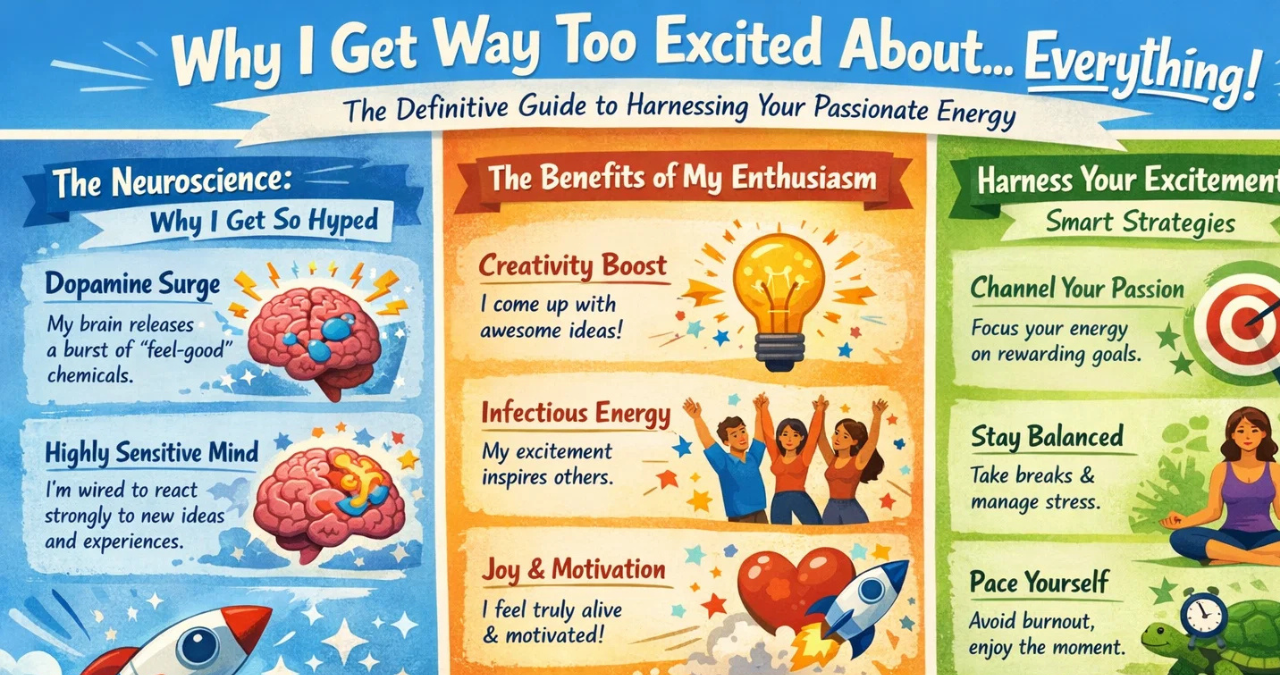
I get way too excited about When you feel you get way too excited about something, it’s not just “in your head” in the colloquial sense—it’s a literal, spectacular fireworks display inside your head. This reaction is governed by a powerful cocktail of neurochemicals. The initial spark often originates from dopamine, the neurotransmitter associated with reward, anticipation, and desire. It’s less about pleasure itself and more about the pursuit, the “wanting.” When you see the notification for that long-awaited package or step into a conference for your favorite topic, dopamine surges, driving your attention and motivation into overdrive.
I get way too excited about This dopamine rush is frequently accompanied by norepinephrine, which sharpens your focus and elevates your heart rate, and serotonin, which boosts your mood. In truly peak moments, the body may even release endorphins, creating a natural euphoria. This isn’t a system error; it’s your brain’s sophisticated engagement circuitry firing at full capacity. It’s designed to flag what is novel, rewarding, and essential for your growth or survival, screaming, “This matters! Pay attention!” The feeling of being “too” excited simply means your brain is exceptionally efficient at this signaling process.
Societal Conditioning and the “Cool” Facade
I get way too excited about Despite the brilliant biology behind it, uninhibited excitement often meets social friction. From a young age, many are subtly or directly taught to dampen their enthusiasm. The messaging is pervasive: “Calm down,” “Don’t be so dramatic,” “Play it cool.” This conditioning is rooted in a desire for social equilibrium and control. Unexpressed emotion is often mistakenly equated with maturity, professionalism, and intelligence. The archetype of the stoic, unflappable leader or the aloof, cool individual is persistently glorified.
I get way too excited about Consequently, those who feel they get way too excited about their interests can internalize a sense of shame. They may start to self-censor, fearing judgment for being “childish,” “needy,” or “over-the-top.” This creates a painful dichotomy where their authentic, joyful self is at odds with their perceived social self. The energy that could fuel connection and creativity is diverted into suppression and anxiety. Recognizing this conditioning is the first step toward reclaiming your excitement as a valid and valuable form of emotional expression.
Excitement vs. Mania: Understanding the Spectrum
I get way too excited about It’s crucial to distinguish between healthy, passionate excitement and states that may signal a deeper consideration. Passionate excitement is typically event-responsive, proportionate, and leads to positive outcomes like connection, learning, or creation. You might get way too excited about a new video game and lose track of an evening, but you still meet your basic responsibilities, and the feeling settles.
I get way too excited about Mania or hypomania, in a clinical sense, is different. It’s a sustained, elevated mood state that is often disconnected from external events, lasts for days or weeks, and can be accompanied by impulsivity, grandiosity, a decreased need for sleep, and behaviors with high-risk consequences. The key differentiators are duration, context, and functional impact. The table below clarifies these distinctions to provide context and reassurance.
| Feature | Healthy, Passionate Excitement | Clinical Mania/Hypomania |
|---|---|---|
| Trigger | Tied to a specific, identifiable stimulus or interest. | Often arises without clear external cause; mood is elevated “out of nowhere.” |
| Duration | Temporary, often hours or a day, fading naturally. | Persists for multiple days to weeks, as a sustained state. |
| Sleep Patterns | Might stay up late occasionally due to enthusiasm, but body can still rest. | Markedly decreased need for sleep (e.g., feeling rested after 2-3 hours for nights). |
| Impact on Function | May cause temporary distraction but core responsibilities are generally met. | Often leads to significant impairment in work, social, or personal functioning. |
| Behavioral Outcomes | Leads to engaging hobbies, sharing joy, creative projects. | Can lead to high-risk, impulsive acts with painful consequences (financial, relational). |
| Self-Awareness | Often includes self-conscious thought (“I’m so excited!”). | Often lacks insight; the individual may not perceive their behavior as unusual. |
| Aftermath | Leaves positive feelings, memories, or tangible creations. | Frequently followed by a “crash” into depression or exhaustion, with regret. |
The Hidden Strengths of the Enthusiastic Mind
I get way too excited about The tendency to get way too excited about topics or events is a signature of a particular cognitive and emotional style rich with strengths. One of the most significant is hyperfocus. When a subject captures your passionate interest, your brain can enter a state of deep, almost flow-like concentration where hours feel like minutes. This isn’t a mere distraction; it’s a powerful gateway to rapid skill acquisition, intricate problem-solving, and masterful creativity. What looks like “obsession” to an outsider is often a profound depth of engagement.
I get way too excited about Furthermore, this excitability is the engine of resilience and motivation. The dopamine-driven anticipation associated with your passions creates a powerful internal reward system. This system makes perseverance through mundane or challenging tasks related to that interest not only possible but enjoyable. Your excitement becomes a renewable fuel source for long-term projects. It also fosters authentic connection, as your genuine enthusiasm is magnetic, attracting like-minded people and creating relationships built on shared passion rather than mere convenience.
Channeling Excitement into Creative Output
I get way too excited about The raw energy of excitement is volatile; left uncontained, it can dissipate as nervous energy or anxious chatter. The key to harnessing it is concrete channeling. When you feel that surge because you get way too excited about a new idea, instantly direct it into a physical or digital form. Open a notebook and brain-dump every thought. Open a blank document and start an outline. Grab your instrument and record a riff. This act of immediate capture transforms amorphous energy into a tangible first draft, a prototype, a seed.
I get way too excited about This process does two critical things. First, it externalizes the looping thoughts, freeing up mental RAM and reducing the feeling of being overwhelmed by your own ideas. Second, it builds momentum. That first sentence or sketch, however rough, is infinitely more valuable than the perfect idea trapped in your head. It creates a “hook” for your future, less-excited self to return to and refine. Your excitement becomes the spark, and this practice builds the forge where that spark can create lasting fire.
The Social Dynamics of Shared Enthusiasm
I get way too excited about Navigating the social world with a passionate temperament requires a delicate radar. Your excitement is a gift, but like any gift, its reception depends on the recipient. The concept of “watering where the garden grows” is essential. In environments with shared interests—a book club, a coding forum, a sports bar during the big game—your enthusiasm is the currency of connection. It builds rapport, energizes the group, and fosters a sense of communal joy. Here, you are not “too much”; you are the heartbeat of the interaction.
I get way too excited about Conversely, in neutral or unrelated settings, unfiltered excitement can be perceived as a non-sequitur or a demand for emotional labor from others. The skill lies in calibration. This doesn’t mean dimming your light, but focusing its beam. Gauge interest with exploratory questions (“Are you into fantasy novels?”). Match the other person’s energy level. Find the enthusiasm conduit—the one person in the room whose eyes light up at your topic. As an expert in organizational psychology once noted, “Passion is contagious, but context is the carrier. The most influential people know not just what to share, but when and with whom to create a resonant exchange.”
Building Resilience Against Excitement Shaming
I get way too excited about For those who have repeatedly been told to temper their joy, building resilience is a conscious practice. It begins with reframing the internal narrative. When the thought “I’m being too much” arises, challenge it. Replace it with, “I am expressing my authentic engagement,” or “My passion is a strength.” This cognitive shift dismantles the internalized critic. Surround yourself with evidence anchors—mementos, playlists, saved messages—that remind you of the joy and results your excitement has generated.
I get way too excited about Furthermore, curate your inner circle and input deliberately. Actively seek out communities, social media feeds, and friendships that not only tolerate but celebrate passionate discourse. Distance yourself from voices that consistently pathologize your enthusiasm. This isn’t about creating an echo chamber, but about building a foundational support system where your authentic self is validated. This secure base gives you the strength to navigate less receptive environments without internalizing their limitations.
Strategic Energy Management for Passionate People
I get way too excited about The high-octane fuel of excitement burns brightly but can lead to burnout if not managed. This requires moving from spontaneous reaction to strategic allocation. Think of your excitement energy as a precious resource in a reservoir. You must invest in replenishment activities that fill it: immersive hobbies, nature time, or consuming inspiring content. These are not frivolous; they are essential maintenance for your cognitive and emotional engine.
I get way too excited about Simultaneously, you must install conscious release valves. Schedule deep-dive sessions for your passions. Use timers to create contained, intense periods of engagement (e.g., a 90-minute “excitement sprint”) followed by a mandatory break. This structure honors your drive while protecting you from depletion. It also transforms the excitement from a potential source of anxiety (“I should be working on this!”) into a scheduled, guilt-free appointment with your joy, ensuring it enhances your life rather than disrupts it.
When Excitement Becomes a Professional Superpower
I get way too excited about In the professional realm, the very trait you may have hidden can become your most distinguishing asset. The individual who I get way too excited about industry trends, user experience细节, or innovative solutions is the one who drives progress. This excitement translates directly into proactive initiative. You’re not waiting for assignments; you’re bringing ideas, fueled by your innate curiosity and desire to explore what’s new and possible.
I get way too excited about To leverage this professionally, pair your excitement with structured communication. Translate your buzzing ideas into a one-page brief, a prototype, or a data-backed slide. Frame your enthusiasm in terms of value: “I’m really excited about this new approach because I see a potential 15% efficiency gain.” This demonstrates that your passion is not mere emotion, but the driver of tangible results. It makes you the indispensable innovator, the engaged team member, and the inspirational leader who sees potential where others see routine.
The Role of Mindfulness in Moderating Intensity
I get way too excited about Mindfulness is not about extinguishing your excitement; it’s about installing an observer in the control room. Practices like brief meditation or focused breathing develop meta-awareness—the ability to notice you are getting excited, without being completely swept away by the wave. You can think, “Ah, here’s that big surge of excitement about the project launch,” and feel the physical sensations—the quickened pulse, the flutter—without immediately needing to act on them.
I get way too excited about This pause is transformative. It creates a critical space between stimulus and response. In that space, you regain agency. You can choose how to express the energy: with a focused action plan instead of scattered texts, or with a deep breath before a measured, impactful announcement instead of an uncontrolled outburst. This mindful management doesn’t dilute the excitement; it distills it, making it more potent, intentional, and effective in the world.
Cultivating a Lifestyle That Honors Your Passionate Nature
I get way too excited about Ultimately, integrating this trait means designing a life that doesn’t just accommodate your passionate nature but is built upon it. This is an ongoing practice of authentic alignment. It involves making choices—from career paths to weekend activities—that have a high probability of triggering your genuine excitement. It means giving yourself unconditional permission to explore niche interests without requiring a monetizable outcome or external validation.
I get way too excited about This lifestyle prioritizes curiosity over coolness. It embraces the understanding that a life punctuated by moments where you get way too excited about things is a life rich with engagement, learning, and color. It’s about collecting experiences that make your heart pound with joyful anticipation, not just possessions. By building your days around these sparks, you move from occasionally feeling excited to living an exciting, purpose-driven life, where your enthusiasm is the compass guiding you toward your truest self.
Conclusion
I get way too excited about The journey from wondering “why do I get way too excited about everything?” to declaring “my excitement is my compass” is one of profound self-reclamation. That intense, sometimes overwhelming surge of enthusiasm is not a character flaw to be corrected, but a neurological gift to be understood and a strategic asset to be deployed. It is the engine of deep focus, the spark of creativity, and the melody of authentic connection. Throughout this exploration, we’ve seen that the key lies not in suppression, but in sophisticated channeling—transforming raw, volatile energy into focused action, meaningful creation, and resilient joy.
I get way too excited about Embrace the full voltage of your passionate nature. Use the frameworks of neuroscience, energy management, and social calibration not to diminish your light, but to focus it into a beam that can illuminate your path and warm those around you. Your capacity for excitement is a direct line to what makes you feel most alive. Stop apologizing for it. Start building with it. The world doesn’t need more people playing it cool; it needs more people passionately, intelligently, and unashamedly engaged. Your next moment of getting way too excited about something isn’t an interruption—it’s an invitation. An invitation to dive deeper, create braver, and connect truer. Say yes.
Frequently Asked Questions
Is it a bad sign that I get overly excited so easily?
I get way too excited about Not at all. While it’s wise to be self-aware, easily triggered excitement is often a sign of a curious, engaged, and passionate mind. It indicates a brain that is highly responsive to novel and rewarding stimuli. The “bad sign” would be a chronic lack of excitement or joy. The goal is not to feel less, but to learn the most empowering ways to express and channel those feelings.
How can I stop feeling embarrassed when I get way too excited?
The embarrassment usually stems from internalized messages, not from the excitement itself. Start by reframing your self-talk. Instead of “I’m being annoying,” try “I’m expressing genuine joy.” Seek out affirming communities where your passion is welcomed. With practice, you’ll build an internal identity where your enthusiasm is a point of pride, not shame.
Can my tendency to get way too excited about things be linked to ADHD or neurodiversity?
I get way too excited about Yes, it can be a very common trait in neurodivergent individuals, particularly those with ADHD or Autism. The neurochemical systems governing reward, focus, and emotional regulation can lead to intense hyperfocus and passionate “special interests.” If this excitement pattern is part of a broader set of life challenges (like focus dysregulation), understanding it through a neurodiversity lens can be incredibly validating and open doors to helpful strategies.
What’s the difference between being excited and being impulsive?
Excitement is an emotional and physiological state. Impulsivity is an action taken without forethought, often driven by that state. You can feel you get way too excited about a new business idea (emotion) without impulsively quitting your job the next day (action). The mindfulness techniques discussed help you feel the full excitement while maintaining the choice of a strategic, rather than reactive, response.
How do I explain my excited nature to a more reserved partner or friend?
Frame it as a difference in wiring, not a deficiency. You could say, “I’ve learned that my brain gets really lit up by new ideas, and I express that energy outwardly. I know your style might be more contained, and I respect that. My excitement isn’t a demand for you to match it—it’s just me being me.” This opens a conversation about how you can both feel comfortable being your authentic selves together.
You may also read
Blog.UsefulIdeas.Net: Your Definitive Guide to Content Strategy Mastery


