
Do the Driving Modes in Cadillac Lyriq Offer Different Ranges or Battery Usage?.The Cadillac Lyriq represents a bold stride into the future of electric luxury, blending serene comfort with impressive technological capability. For the discerning EV driver, understanding how to extract the most from their vehicle is paramount. A central question that emerges, beyond sheer power and features, is one of intelligent energy management. Specifically, do the driving modes in Cadillac Lyriq offer different ranges or battery usages? The answer is a definitive and nuanced yes. Each driving mode is a sophisticated software-engineered profile that actively recalibrates the vehicle’s core systems—from powertrain response and suspension damping to climate control and regenerative braking—directly influencing how kilowatt-hours are consumed from the battery pack. This article will serve as your comprehensive guide, dissecting each mode’s philosophy, its tangible impact on efficiency, and providing actionable strategies to harness these digital tools for extending your driving range or unleashing the Lyriq’s exhilarating performance, all while deepening your understanding of modern EV dynamics.
Understanding the Philosophy Behind Lyriq’s Driving Modes
Cadillac engineered the Lyriq’s driving modes not as simple performance toggles, but as holistic vehicle personas. Each mode is designed to curate a specific driving experience by orchestrating the behavior of multiple vehicle subsystems in concert. The primary goal is to give the driver intentional control over the character of the vehicle, aligning it with their immediate needs, whether that’s maximizing mileage on a long trip, enjoying a spirited drive on a winding road, or ensuring maximum confidence in challenging weather.
This orchestration means that when you select a mode, you’re not just changing the throttle map. You’re potentially altering motor output, steering weight, the stiffness of the adaptive suspension (if equipped), the aggressiveness of the regenerative braking, and even the climate system’s strategy. It is this interconnected recalibration that directly leads to variations in energy consumption. Therefore, examining if the driving modes in Cadillac Lyriq offer different ranges requires us to look at this systemic interplay, not just a single variable.
A Deep Dive into Tour Mode: The Balanced Baseline
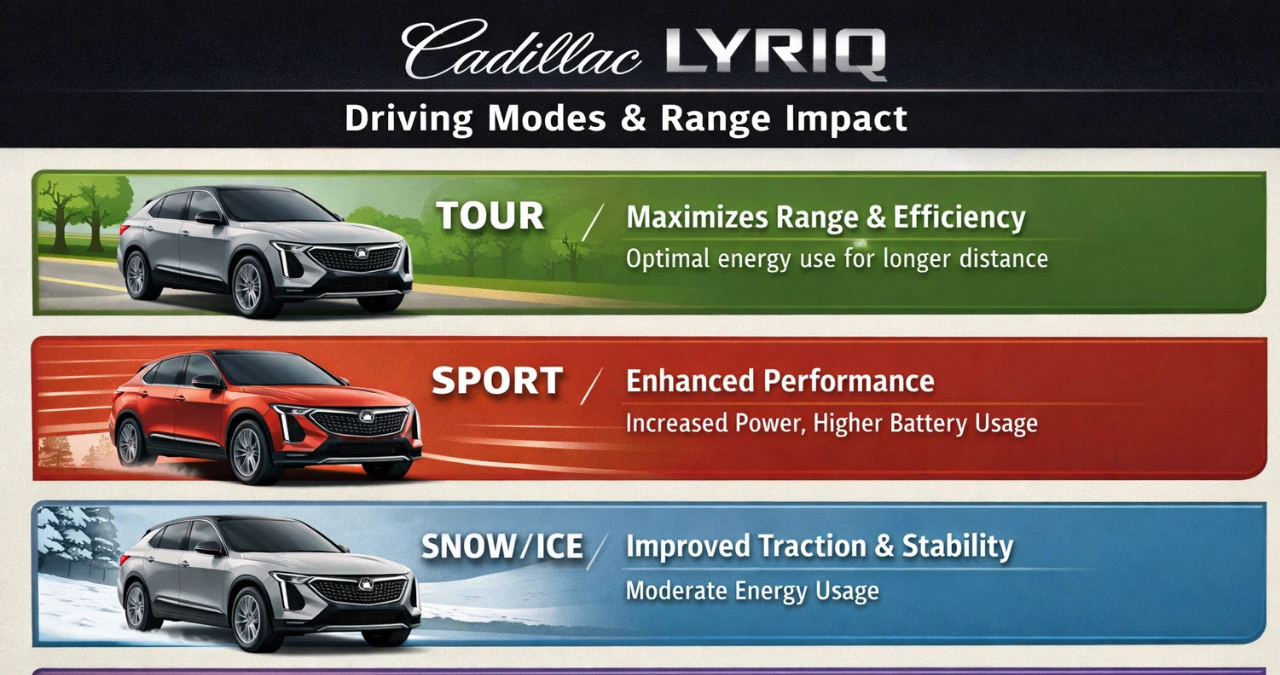
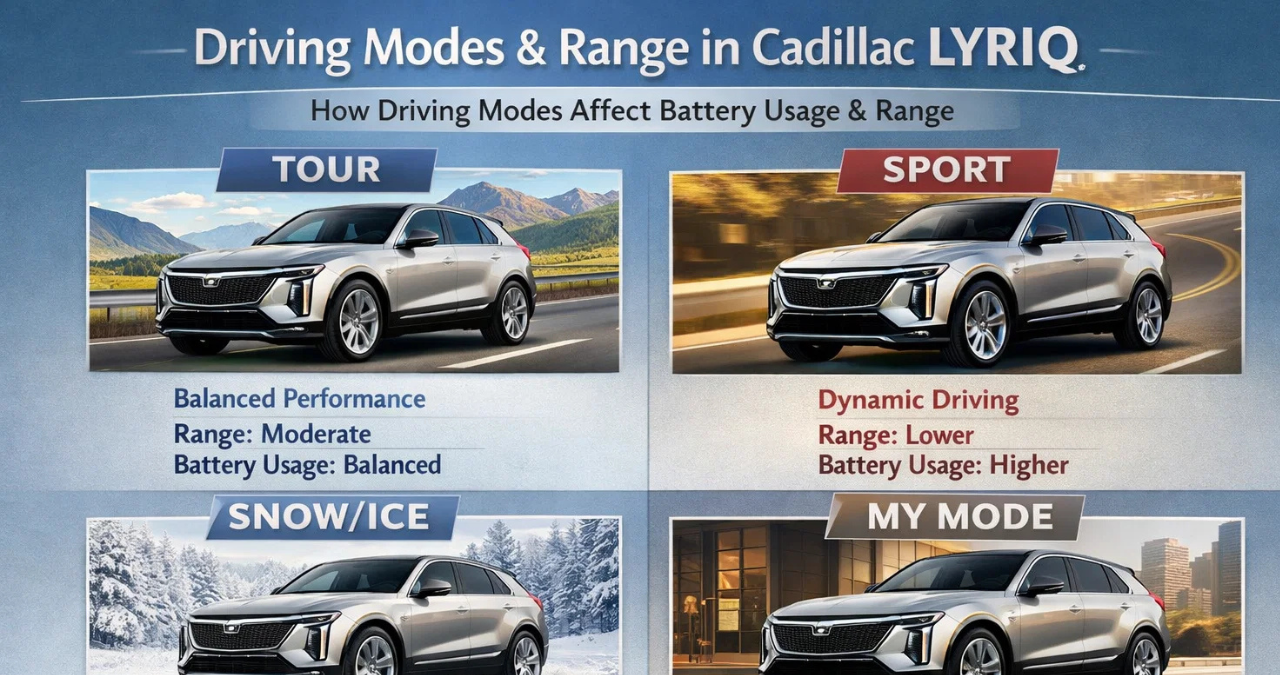
Tour mode is the Lyriq’s default setting, meticulously calibrated to deliver the quintessential Cadillac experience: smooth, quiet, and effortlessly powerful. In this mode, the dual-motor all-wheel-drive variants (or the rear-wheel-drive motor) provide linear and confident acceleration, the steering offers refined feedback, and the ride quality prioritizes supple comfort over sporty tautness. The climate control and ancillary systems operate with a standard efficiency profile, making no special concessions for energy saving beyond their normal optimized function.
From a range perspective, Tour mode serves as the critical baseline. It offers an excellent balance between performance and efficiency, making it ideal for daily commuting and highway cruising. The energy consumption here is what Cadillac engineers used to calculate the official EPA range estimates. You can expect predictable and consistent battery usage in Tour, providing a real-world reference point against which the other modes’ efficiency impacts can be measured. It’s the “set it and forget it” mode for most conditions.
Unleashing Performance: The Dynamics of Sport Mode
Engaging Sport mode fundamentally transforms the Lyriq’s demeanor from a serene cruiser to an agile performance SUV. The change is immediate and palpable. Throttle response becomes razor-sharp, delivering maximum motor torque with minimal pedal input. Steering feel tightens and weights up for improved precision, and the adaptive dampers firm up significantly to reduce body roll and improve cornering stability. The regenerative braking may also be tuned to allow for more coasting, giving the driver greater control during aggressive driving.
This heightened performance envelope comes with a clear thermodynamic cost. The constant readiness for peak power output, combined with the energy required to continuously adjust the suspension and the typically less efficient driving style Sport mode encourages, leads to higher battery usage. While exhilarating for shorter bursts, sustained driving in Sport mode will indisputably reduce your total range compared to Tour or more efficient settings. It answers the question of whether driving modes affect battery usage with a resounding, energy-intensive yes.
The Efficiency Champion: How Snow/Ice Mode Conserves Energy
Contrary to what some might assume, Snow/Ice mode is a masterclass in efficient, controlled power delivery. Its primary engineering objective is to maximize traction and stability on low-grip surfaces. It achieves this by dramatically softening throttle response, prioritizing the use of the front motor in AWD models for more stable pulls, and invoking the traction and stability control systems at their most sensitive settings. Acceleration is deliberately muted and linear to prevent wheel slip.
This very strategy of inhibiting sudden, high-torque applications is inherently efficient. By preventing wasteful wheel spin and smoothing out power delivery, the vehicle minimizes a significant source of energy loss. The motor operates in a more controlled, lower-amperage band. Consequently, while designed for safety, Snow/Ice mode often results in surprisingly low energy consumption. It’s a clear example where a driving mode in the Cadillac Lyriq can offer a different, and in this case improved, range potential, albeit within the specific context of low-speed, cautious driving on slippery roads.
The One-Pedal Driving Expert: Understanding the Impact of Regenerative Braking
While not always labeled as a separate “driven” mode, the Lyriq’s regenerative braking system, particularly its “One-Pedal Driving” feature accessible via the steering wheel paddles, is arguably the most powerful tool in the efficiency arsenal. When fully engaged, One-Pedal Driving allows you to accelerate, coast, and decelerate to a complete stop using only the accelerator pedal. Lifting off the pedal commands a strong regenerative braking force, which converts the vehicle’s kinetic energy back into electrical energy to recharge the battery.
The impact on range and battery usage here is direct and substantial. By recapturing energy that would otherwise be lost as heat through the traditional friction brakes, One-Pedal Driving can significantly increase real-world efficiency, especially in stop-and-go city traffic. The degree of regeneration is adjustable, allowing you to tailor its aggressiveness. Maximizing regeneration is a driver-controlled action that complements the broader vehicle profiles, providing a secondary layer of efficiency management beyond the primary driving mode selection.
The Role of Adaptive Suspension and Steering in Energy Consumption
For Lyriq models equipped with Magnetic Ride Control adaptive dampers and variable-ratio steering, the driving mode selection has an additional, subtler layer of energy implication. In Tour mode, the suspension is soft, allowing greater wheel travel to absorb road imperfections. This can have a minor aerodynamic effect at high speeds but is generally neutral for efficiency. The steering is light, requiring minimal effort from the electric power steering pump.
In Sport mode, the system constantly energizes the magnetic particles in the damper fluid to stiffen the shocks, a process that consumes a small but continuous amount of electrical energy. Furthermore, the firmer suspension lowers ride height slightly, which can improve aerodynamic efficiency. The heavier steering feel also demands more from the power steering system. The net effect of these subsystem adjustments on overall range is marginal compared to powertrain changes, but it illustrates the comprehensive nature of each mode’s recalibration, contributing to the holistic answer of how driving modes affect battery usage.
Climate Control Systems and Their Hidden Battery Drain
A frequently overlooked yet major contributor to battery usage is the vehicle’s climate control system. The driving modes in the Cadillac Lyriq can influence this system’s behavior. In Tour mode, the climate control operates for optimal passenger comfort with standard efficiency. However, in more range-focused driving strategies—often managed through a separate “Range” or “Efficiency” screen in the infotainment system—the vehicle may automatically engage an “Eco” climate setting.
This Eco climate mode reduces the workload of the HVAC compressor and fan, potentially relying more on seat and steering wheel heaters (which are far more efficient at directly warming the occupant) to conserve energy. Using the preconditioning feature while the Lyriq is still plugged in is the single best practice to mitigate climate-related range loss, as it heats or cools the cabin using grid power before you depart, preserving the battery’s charge for driving. This ancillary system management is a critical part of the range puzzle.
Real-World Testing: Quantifying the Range Differences Between Modes
Theoretical understanding is bolstered by real-world data. While individual results vary based on driving style, terrain, and weather, consistent patterns emerge from controlled testing and owner experiences. Tour mode typically delivers consumption figures very close to the Lyriq’s advertised EPA rating, often averaging between 2.8 to 3.2 miles per kWh depending on configuration. Sustained use of Sport mode in mixed driving can see that efficiency number drop by 15-25%, directly translating to a proportionally reduced range.
Conversely, employing a conservative strategy using Tour mode combined with aggressive regenerative braking and Eco climate settings can often match or slightly exceed EPA estimates, especially in urban environments. Snow/Ice mode, due to its inherent power limitations, can show efficiency numbers similar to or even better than Tour in the specific low-traction scenarios for which it’s designed. The following table provides a structured insight into these expected variances.
Cadillac Lyriq Driving Modes: Estimated Impact on Efficiency & Range
| Driving Mode | Primary Character | Key System Adjustments | Estimated Efficiency Impact (vs. Tour Baseline) | Best Use Case Scenario |
|---|---|---|---|---|
| Tour | Balanced, Comfortable | Linear throttle, standard suspension & steering, normal climate. | Baseline (0%) | Daily driving, highway trips, optimal balance of comfort and range. |
| Sport | Agile, Performance-Oriented | Sharp throttle, firm suspension, weighted steering, reduced regen. | Decrease of 15-25% | Spirited driving on curving roads, short bursts for performance enjoyment. |
| Snow/Ice | Stable, Secure, Cautious | Very soft throttle, front-biased AWD (if equipped), high traction control. | Variable; Can be Similar or Slightly Better | Snow, ice, rain, or loose gravel where traction is the priority. |
| One-Pedal (Max) | Efficient, Controllable | Maximum regenerative braking force enabled via paddle. | Increase of 5-15% (in city traffic) | Stop-and-go urban commuting, descending hills, maximizing recaptured energy. |
Strategic Driving: When to Use Which Mode for Optimal Range
The art of maximizing your Lyriq’s range lies in the strategic application of its driving modes. For long-distance travel where maximizing miles per charge is critical, Tour mode should be your default. Pair it with the highest regenerative braking setting you find comfortable and utilize the Eco climate feature if conditions allow. This combination provides the most efficient baseline without sacrificing essential comfort or drivability.
Use Sport mode judiciously—for the mountain pass, the on-ramp, or when you simply want to enjoy the Lyriq’s dynamic capabilities, fully accepting the temporary increase in energy consumption. Snow/Ice mode should be deployed automatically when road conditions deteriorate; its range impact is irrelevant compared to its safety benefit. Remember, preconditioning while plugged in is a non-negotiable best practice in extreme temperatures. As EV expert and automotive engineer David Andrews notes, “Modern EV driving modes are like having an expert co-pilot for your battery. They don’t just change the feel of the car; they rewrite its energy management playbook in real-time.” This encapsulates the intelligent design at work.
Common Misconceptions About EV Driving Modes and Efficiency
A prevalent misconception is that an “Eco” or range-optimized mode severely cripples performance to an unacceptable degree. In the Lyriq, even its most efficient configuration retains ample power for safe merging and passing; it simply delivers that power more progressively. The limitation is in the pedal’s sensitivity, not the vehicle’s ultimate capability. Another myth is that AWD models are always less efficient. In the Lyriq, the AWD system can decouple the front motor during steady-state cruising, effectively operating as a RWD vehicle to save energy.
Furthermore, some believe driving mode selection is the only factor in range. In reality, external factors like ambient temperature, speed (aerodynamic drag increases with the square of velocity), and tire pressure are equally or more influential. The driving modes are powerful tools within the driver’s control, but they operate within the larger physical constraints of the environment. Understanding this helps set realistic expectations.
The Future of Software-Defined Efficiency in EVs Like the Lyriq
The Cadillac Lyriq, with its Ultium platform and extensive software integration, points toward the future of “software-defined vehicles.” This means the potential for driving modes and their efficiency characteristics is not static. In the future, over-the-air (OTA) updates could introduce entirely new driving modes, refine existing ones, or even provide personalized efficiency profiles based on an individual’s driving habits and frequent routes.
We could see modes that utilize real-time navigation and traffic data to pre-condition the battery for optimal efficiency on a known route, or “Predictive Range” modes that automatically adjust system parameters based on remaining charge and distance to the next charger. The question of whether the driving modes in Cadillac Lyriq offer different ranges will become even more dynamic, with the vehicle intelligently suggesting or automating mode shifts to ensure you reach your destination with maximum efficiency and minimal stress.
Conclusion
The interplay between driving modes, range, and battery usage in the Cadillac Lyriq is a sophisticated dance of software, hardware, and driver intention. To the central question—do the driving modes in Cadillac Lyriq offer different ranges or battery usages?—the evidence is clear and multifaceted. Yes, each mode creates a distinct energy consumption profile by holistically reconfiguring the powertrain, chassis, and ancillary systems. Tour mode provides the balanced benchmark, Sport mode trades range for thrilling performance, and Snow/Ice mode promotes an efficient, safety-first driving style. The regenerative braking system, particularly One-Pedal Driving, stands as a separate but vital efficiency lever.
Ultimately, the Lyriq empowers you with intelligent choice. By understanding the purpose and impact of each setting, you can transition from a passive driver to an active energy manager. You can confidently select a mode that aligns with your priorities for any given journey, whether it’s maximizing the distance to the next charger, enjoying the responsive power of an electric luxury SUV, or navigating safely in inclement weather. This knowledge transforms the Lyriq from a mere vehicle into a capable and adaptable partner on the road.
Frequently Asked Questions
What is the most efficient driving mode in the Cadillac Lyriq?
For overall efficiency, Tour mode paired with a high regenerative braking setting (like One-Pedal Driving) is typically the most effective combination. This setup provides a smooth, controlled driving experience while maximizing energy recapture during deceleration. It directly illustrates how the driving modes in Cadillac Lyriq offer different range potentials through system calibration.
Does using Sport mode all the time damage the battery?
No, using Sport mode does not damage the battery. The Lyriq’s battery management system is designed to handle the higher power demands of Sport mode safely. However, consistent use will lead to faster battery depletion and higher energy consumption, reducing your overall range per charge. It’s a matter of usage, not damage.
Can I customize the individual settings within a driving mode?
The level of customization depends on the model year and trim. While you may not be able to create fully custom “My Mode” profiles on all versions, you can often independently adjust the regenerative braking strength via the steering wheel paddles regardless of the selected driving mode, giving you fine-tuned control over one of the key efficiency factors.
How much range can I actually gain by using One-Pedal Driving?
The range gain from One-Pedal Driving is highly situational. In dense urban traffic with frequent stops, it can improve efficiency by 5-15% or more by recapturing significant energy. On a steady highway drive with few slowdowns, its benefit is minimal. It’s a tool that best answers how driving modes (and related features) affect battery usage in city conditions.
Should I use Snow/Ice mode just to save battery in normal conditions?
It is not recommended. While Snow/Ice mode can be efficient due to its muted throttle, it significantly dulls performance and is designed for low-traction scenarios. Using it on dry pavement defeats its safety purpose and provides an unsatisfying driving experience. For efficiency in normal conditions, stick to Tour mode with high regen for a better balance of range and drivability.


