

The Great Gatsby Covers. When you pick up a copy of The Great Gatsby, one of the first things that catches your eye is the cover. That cover is not merely packaging it is a visual overture, a mood-setter, a promise of what awaits inside. From the shimmering Art Deco hues to the symbolic green light and piercing eyes hovering above a cityscape, the cover of The Great Gatsby speaks in imagery what the novel speaks in prose: ambition, illusion, excess, and longing. In this article, we’ll stroll through the fascinating world of The Great Gatsby covers how they came to be, what they communicate, how they have changed over time, and why they matter deeply for readers, collectors, and designers alike.
Origins: The First Edition Cover and Its Symbolism
When the novel was first published in 1925 by Charles Scribner’s Sons, the dust jacket bore the now-legendary artwork by Francis Cugat (often credited as “Francis Cugat”). The image, titled Celestial Eyes, shows a pair of haunting flapper-style eyes and red lips floating above a dark blue cityscape with twinkling lights.
This cover is not just decor it offers a visual metaphor for much of what the novel explores. The eyes seem detached, almost omniscient, looking out from above; the city lights suggest both the glamour and the emptiness of the Jazz Age; and the greenish hint under one eye evokes the novel’s green light motif and the elusive dream of its protagonist.
In fact, Fitzgerald himself acknowledged that the cover influenced his text. When he saw Cugat’s draft, he was so taken by it that he wrote into the manuscript a description that echoes the disembodied face floating above the cornices he had just seen. So the cover became more than an adornment it shaped the novel itself.
Thus, the first edition cover stands as a visual partner to the text: setting tone, injecting mystery, and inviting the reader to look more deeply. It signals that we are about to enter a world where appearance and reality blur, where dreams glimmer at night, and where the cost of ambition may be far greater than the reward.
Visual Elements and What They Convey
Looking closely at the cover, one can pick out a number of design elements that resonate with the novel’s themes: the detached face, the green light, the cityscape, the eyes, and the color contrasts. Let’s unpack some of them.
The Floating Face and Eyes
The image of a floating, disembodied face has an uncanny effect. It suggests distance, surveillance, and longing. The eyes look out, yet they are not part of a full human figure one senses emptiness behind the spectacle. According to art historians, these eyes echo the billboard of the optometrist Doctor T. J. Eckleburg that appears within the novel, symbolizing moral oversight or the watcher of the human spectacle.
At the same time, the lips add an element of sensuality, suggestion. The woman is not fully present; she is a symbol of desire, a dream figure, perhaps even a mirage. The floating visage thus conveys both attraction and distance just as Gatsby is drawn to Daisy yet can never fully possess her.
The Cityscape and Twinkling Lights
Beneath the face lies a field of lights evocative of skyscrapers, amusement parks, neon, the shimmering surface of the Roaring Twenties. The novel’s setting of Long Island, New York, East Egg, West Egg, parties, and jazz all come to mind. The cover invites you into that spectacle.
However, the cityscape is distant, composed of sparkles rather than details. That denies solidity, implying that the glitter is superficial that beneath the dazzle there might be emptiness. The contrast between the flamboyant surface and the hollow core is one of Fitzgerald’s deepest concerns.
The Green Light and the Tear
If you look carefully, there is a slender green line beneath one eye, which many interpret as a tear, or as the green light at the end of Daisy’s dock reaching across the water to Gatsby. The symbolism is rich: hope, longing, envy, and ambition all wrapped in one. The color green here is not merely decorative; it is central. The cover thus foretells the novel’s central motif: the green light as a beacon, as an unreachable dream.
Color, Composition, and Style
The use of dark blue (night sky), bright lights (glamour), and red lips (passion) creates a dramatic composition. The Art Deco style is present in the abstraction and geometry. The cover doesn’t try to be photographic or literal; instead, it evokes mood, impression, and sensation. This abstraction echoes the novel’s own layering of reality and illusion. Scholars note that the cover art is arguably one of the first in literary history to influence the text it adorns.
In short, the cover functions on multiple levels: aesthetic, symbolic, and thematic. It sets you up for a story about appearance versus reality, about dreams shimmering in the night, about the price of ambition.
Evolution: How Covers Changed Over Time
Over the decades, The Great Gatsby has appeared in thousands of editions worldwide and with that comes a vast array of cover designs. Some retain the iconic eyes and cityscape; others radically reinterpret the novel for a new age or market. According to one compilation, there are at least 42 languages and innumerable jacket designs.
Retentions and Variations of the Original
Many editions continue to use Cugat’s original cover (or a revised version) because of its iconic status. The lurking face, the lights, the green hint they’ve become part of the novel’s visual identity. For example, the original cover remains in the public domain in the U.S., and you’ll still find it on reissues.
At the same time, publishers have introduced variations: altering color palettes, cropping the face, and adding film-tie-in elements. One Business Insider article shows eleven different covers from around the world Japanese, German, Russian, Spanish each with its own cultural spin.
Cultural and Regional Interpretations
In Japan or Germany or Russia, the cover may foreground different aspects: perhaps the green light, perhaps the car, perhaps Gatsby himself. Some covers emphasise Daisy’s figure; others lean into the decadence of the parties; others reflect minimalistic modern design. The adaptation of the cover to different markets says a lot about how the novel is marketed, perceived, and consumed in different cultures.
For instance, one Russian paperback shows a regal portrait; a Chinese version focuses more on the car imagery or neon lights.
Film Tie-Ins and Special Editions
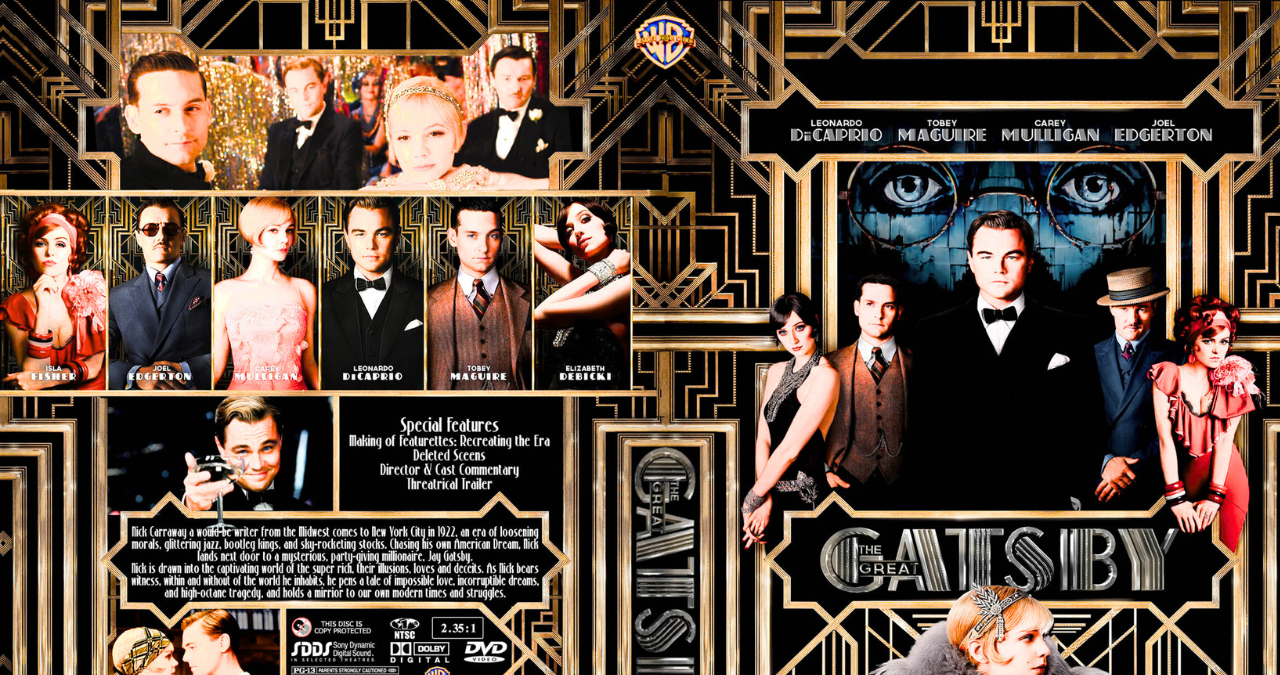
When the 2013 film adaptation of The Great Gatsby was released (directed by Baz Luhrmann), many editions of the novel appeared with new covers featuring actors or film imagery. These tie-in covers lean more commercial they trade on star power and spectacle but at the same time, they bring the novel to a new audience.
Also, deluxe editions (foil stamping, metallic inks, embossed covers) have arrived, treating the novel as a luxury object. The cover, in those cases, becomes part of the value: adding gold foil pages, sculpted embossing, and ribbon marker.
Why These Changes Matter
Cover redesigns matter for more than aesthetic reasons. They reflect how publishers want to position the novel: as a classic to collect, as a modern piece to sell to young readers, as a cultural artefact, as a literary icon. A more minimal design may signal “serious literature,” while a glitzy cover may signal “pop culture rerelease.”
Moreover, each cover overlays a layer of interpretation. If the cover highlights Gatsby’s car, the emphasis becomes his wealth and recklessness. If the cover emphasises the eyes, then the theme of observation and moral baggage comes forward. Thus, the cover design subtly guides the reader’s pre-reading mood and expectation.
Themes and Meaning Through the Cover Lens
What can the study of covers especially the original and its many iterations teach us about The Great Gatsby itself? Quite a lot, in fact. The cover is a lens through which to understand the themes of the novel: illusion, ambition, the American Dream, identity, and observation.
The Illusion vs Reality Dichotomy
The novel repeatedly questions how much of what we see is real, how much is performance. Gatsby, the man, is in large part a performance; Daisy is an image; the parties are a spectacle. The cover with its floating face above a city of lights speaks to that immediately. The eyes are present, but the identity behind them is ambiguous. The city sparkles, but the ground may be ash. The cover tells us: expect a world that dazzles, but also one that hollows.
The American Dream and Its Mirage
Gatsby’s pursuit of his dream (embodied in the green light, in Daisy, in success) is central. The cover’s green hint and its upward gaze conjure ambition reaching toward something distant, perhaps unattainable. At the same time, the dark sky and empty face suggest that such ambitions might be empty or misplaced. The design invites us to reflect on the cost of chasing the dream, and what happens when the dream is more image than substance.
Observation and the Gaze
In the novel, we have Nick, the narrative observer, but we also have the billboard of Doctor T. J. Eckleburg’s eyes, always watching. The cover’s eyes hover above the city watching the spectacle. That suggests that in this world of parties and dreams and illusion, someone is always looking; someone is being looked at. The tension between self-presentation and being observed is baked into both cover and text.
Time, Memory, and Nostalgia
Something is haunting about the cover, like a memory of something lost. The tone of the design is night, distant city lights, a half-face evocative of what has passed, what is lost. Much of the novel is about memory (Gatsby’s longing for the past), and the cover reflects that melancholy. In that way, the cover almost functions as a visual prologue or epilogue: we enter the story under the glow of something half-remembered.
The Cost of Excess
Finally, the city of luminous lights suggests excess, the roaring twenties’ parties, glitter, and glam. The cover offers that surface. But the darkness behind the lights, the detached face, the implied tear they remind us that excess has consequences. This dual signal glamour and grief is central to the novel, and the cover encapsulates it.
Collecting Covers and the Reader’s Experience
For readers, lovers of literature, and collectors, the cover of The Great Gatsby plays a role beyond mere decoration. It invites interaction, reflection, and even value in the marketplace.
The Cover as Invitation
When you choose a book, the cover often triggers your decision: Does this vibe draw me in? With The Great Gatsby, the cover often becomes part of the reading experience. If the cover evokes mystery, you expect mystery; if it highlights the party, you anticipate revelry; if it is minimal and stark, you prepare for something more meditative. Thus, the design primes your reading mindset and shapes your expectations.
Variants and Collectibility
Because The Great Gatsby has been in print for so long and across so many countries, the variety of covers is huge. Early editions with the original cover art are especially prized. The story of Cugat’s original painting (once lost, then found, now held in Princeton) adds to that mystique.
Collectors may seek first editions, dust jacket designs, international editions with unique art, or deluxe special editions with foiling, embossing, and slipcases. The cover becomes part of the artifact’s value. For example, the public domain status of the original cover art in the U.S. (published in 1925) means that many reprints use it, but first editions in good condition still command premium interest.
Reader Identity & Ownership
When you the reader select an edition, you also choose how you present your reading self. A friend might have a classic Unix-style edition with the original face; you might pick a modern minimal design; another friend a film tie-in. What you choose signals something: your taste, how you interpret the novel, even how you want others to view your bookshelf.
Moreover, the cover can shape what you take away from the reading. If the edition emphasises Gatsby’s wealth (via a cover showing his car or mansion), you may read the wealth theme more strongly. If the cover emphasises the green light or the eyes, you may focus on hope or observation. So the cover isn’t just a book jacket it is part of the reading lens.
Future readers, future designs
As reading migrates to digital formats, covers continue to matter: e-book thumbnails, cover art on audio editions, and collector’s editions of print. Designers will keep reimagining The Great Gatsby cover, drawing on new trends, global aesthetics, and readerships. That means the cover remains alive not a relic, but a living part of how the novel gets received generation after generation.
Design Considerations: What Makes a Great Cover for This Novel
If a designer were tasked today with designing a new cover for The Great Gatsby, what lessons might they draw from the history and meaning of its covers? Here are some design considerations emerging from the tradition of Gatsby covers, tied to the novel’s core.
Evoke, Don’t Illustrate
The strongest covers for this novel don’t attempt a photo-realistic depiction of Gatsby, Daisy, or the mansion. Instead, they evoke mood, symbol, and emotion. The floating eyes serve as a metaphor more than a portrait. A designer might focus on a color palette, abstract form, iconography (like the green light), rather than a literal scene. This allows for universality and timelessness.
Symbolism Matters
Because The Great Gatsby is rich in symbolic content (green light, eyes, valley of ashes, parties), incorporating symbols subtly into the cover design strengthens the connection. A clever design might hide a green glow, or a tear, or a silhouette, so that the cover rewards a second glance. The original Cugat cover did exactly this and remains iconic partly for that reason.
Balance Glamour and Hollow
A good design for this novel needs to balance the glitter of the Jazz Age with the novel’s underlying critique of that glitter the hollow, the ash, the darkness behind the lights. Too much sparkle and you risk turning Gatsby into pure glamour; too much bleakness and you lose the jazz and vitality. A nuanced design captures both.
Timeless vs Trendy
Covers the risk of being dated. A design that strongly ties itself to current visual trends may look outdated in a decade. With a book like The Great Gatsby, whose themes remain universal, creating a design that can transcend time is wise. Many editions now emphasize minimal design, restrained color palettes, or typography, so that the cover remains fresh.
Market and Audience Awareness
Designers must also consider how the cover will function in its market. A student edition may need readability and cost-efficient printing; a deluxe edition may invite high-end materials; an international edition may reflect local visual culture. Understanding the audience helps in tailoring the design while remaining true to the novel’s spirit.
Consistency Across Formats
In today’s world, the cover must work in print, ebook thumbnail, audiobook thumbnail, and perhaps even social-media promotion. A design that loses impact when scaled down will lose visibility. Thus, clarity of symbol, strong contrast, and distinctive iconography matter. For a novel whose visual identity is so strong, preserving the recognisability of that identity is a plus.
Why Covers of The Great Gatsby Still Matter
You might wonder: in an age of digital reading and cursory browsing, does the cover of The Great Gatsby still matter? The short answer: yes perhaps more than ever.
First Impressions Still Count
Even in digital formats, readers judge by thumbnail images. A distinctive cover can catch the eye on a crowded online bookshelf. For physical books, a striking cover can prompt a pick-up in a shop, a gift purchase, or a social-media photo. The cover remains the handshake between book and reader.
Cultural Iconography
Because the cover of The Great Gatsby has achieved near-iconic status (especially the Cugat version), it participates in culture beyond the novel. It shows up on merchandise, posters, academic discussions, design courses, and references. Its continued relevance means new covers tap into that legacy or re-imagine it. The visual language of the cover helps keep the novel in the conversation.
Scholarship and Interior Meaning
Students and scholars study the cover as part of the textual apparatus. Knowing how the cover interacts with the novel deepens understanding of themes like the gaze, the green light, illusion vs reality. The cover ceases to be a side detail and becomes interpretative leverage. For example, the way the eyes on the cover echo Doctor Eckleburg’s billboard invites analysis of observation and morality
Market and Collectors
For collectors, covers are significant. First editions, variant covers, international editions, special editions all make a difference in the book’s market value. The better the design and condition of the cover, the more a copy may fetch. For a novel as enduring as The Great Gatsby, cover variants become part of its material history.
Keeps the Novel Alive for New Generations
Every new cover can serve as a reintroduction of the novel to a new generation of readers. A bold, modern reinterpretation may catch the attention of someone unfamiliar with the text; a classic cover may lend gravitas to a classroom edition. The evolving design helps the novel stay current and visible.
In sum: the cover is not peripheral. It is an integral part of how The Great Gatsby exists in the world visually, materially, culturally.
Tips for Readers and Collectors Regarding Covers
If you are a reader looking for an edition of The Great Gatsby or a collector interested in cover variants, here are some useful tips to consider.
For Readers
- Decide what you want: a classic edition, a modern reinterpretation, a deluxe version. If you want something timeless, go for a cover that echoes the original or is minimalist. If you want something trendy, pick a contemporary design.
- Think about readability and format: Some covers prioritise design over readability (e.g., fine script font). Make sure you also like the interior design, margin size, binding, etc.
- Consider the edition’s extras: Some covers come with introductions, footnotes, appendices, or designs that enhance your reading experience. If the cover suggests luxury (foil, embossing), check the rest of the book matches the promise.
- Reflect on your own taste: How do you want the book to sit on your shelf? How will you feel seeing that cover every time? The cover ties into your personal relationship with the book.
For Collectors
- First-edition covers matter. For The Great Gatsby, the first edition (1925) with the original Cugat dust jacket is prized. The condition of the cover (no tears, minimal fading, intact spine) is essential.
- Variant covers can be surprisingly valuable: limited editions, foreign language covers, artwork-based covers, and film tie-ins all can fetch attention.
- Research authenticity: Some covers may be reprints, facsimiles, or modern editions styled after originals. Knowing the publication history helps in assessing value.
- Storage and preservation: Because covers may include delicate foil or embossing, proper storage (acid-free environment, dust jacket protectors, controlled humidity) preserves value.
- Documentation: Take photos, keep receipts, track edition numbers. The story of the cover adds provenance and interest.
Whether you pick a cover for aesthetic pleasure or for investment, knowing the design story behind it enriches your engagement with the book.
A Legacy of Design: Why The Great Gatsby’s Cover Lives On
Why does the cover of The Great Gatsby continue to resonate so strongly? I believe there are several reasons, each reinforcing the other.
First, the design is audacious and memorable. An image of floating eyes above city lights is unusual; it arrests attention and lingers in the memory. Its abstract nature invites interpretation rather than providing clarity. That makes it ripe for cultural longevity.
Second, the design so perfectly mirrors the novel’s themes. When a cover genuinely reflects the text’s concerns appearance vs reality, longing, spectacle, moral cost it becomes more than marketing; it becomes art and literature in conversation. That alignment ensures the design remains meaningful rather than decorative.
Third, the publication history and cultural importance of The Great Gatsby amplify the cover’s status. Because the novel is widely read, taught, and referenced, the cover becomes part of the shared literary culture. New readers pick up the book; designers create new editions; the cover enters discourse. A virtuous cycle.
Finally, the global re-interpretation of the cover keeps it fresh. Every time a new country issues a translation or a new designer reimagines the jacket, the cover evolves while still retaining a core identity. That keeps the visual identity alive and dynamic rather than static.
In short, the cover lives because it both stands for something and invites something. It stands for the novel’s enduring themes; it invites readers, designers, and collectors to keep engaging with the text. That’s why even a century after its first publication, the cover of The Great Gatsby remains conversation-worthy.
Concluding Thoughts
When you open The Great Gatsby, the cover is your first encounter with its world. It whispers a promise: here is glitz, here is longing, here is tragedy, here is dream. It sets the tone, primes your sensitivity to its symbolism, and invites you to read more than just lines on a page.